Pirates don’t need Permission!
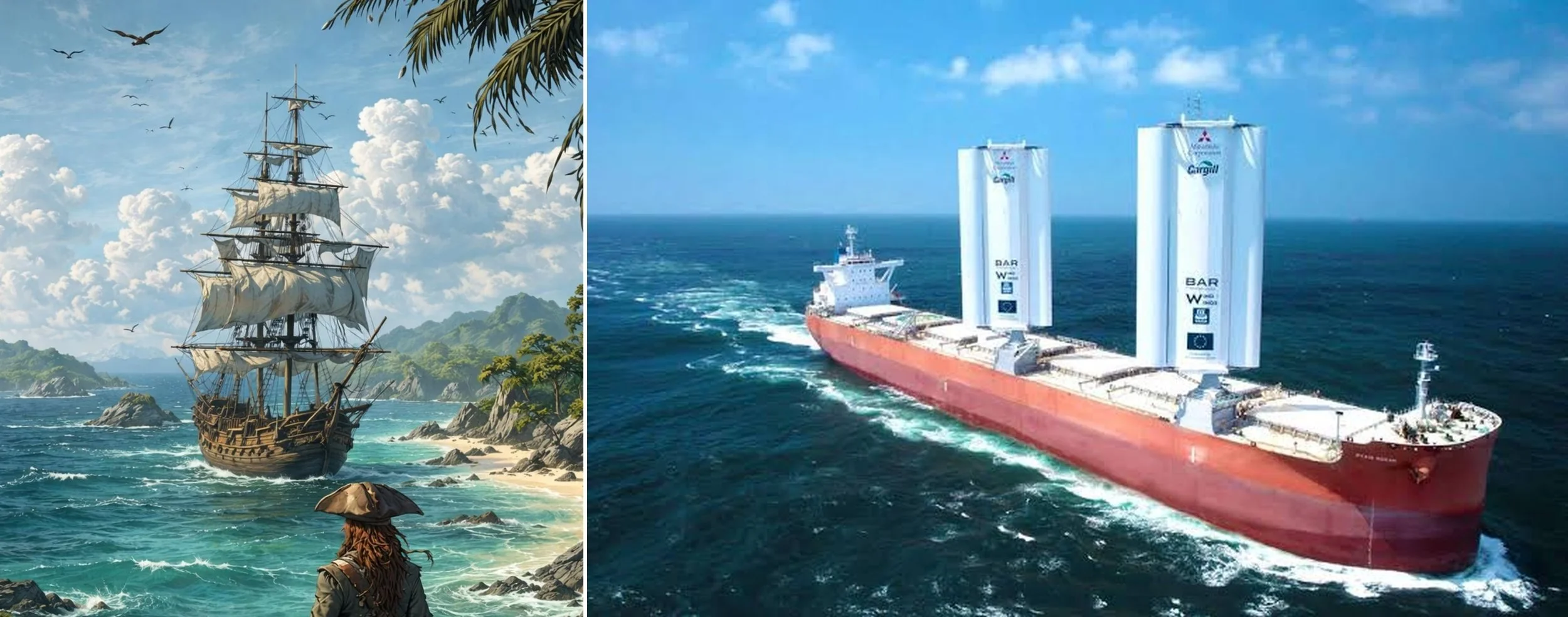
The open ocean is free of many of the constraints found on land: roads, gas stations, zoning laws…..
Pirates didn’t need permission. Neither does the wind.
A ship can point itself toward almost anywhere on Earth and go. No road to build first, no pipeline to lay, no gas station waiting at the other end. That was true when pirates crossed oceans under canvas. And, unexpectedly, it may be one reason some of the most interesting experiments in the energy transition are happening at sea.
In June, a cargo ship called the Tirranna went to sea carrying a sail 46 meters tall and 14 meters wide — roughly the height of a 15-story building, bolted to the deck of a vessel built to haul cars across oceans.
It isn’t a stunt or a museum piece. It’s a commercial wing sail, stiff and rigid like an airplane wing turned on its end, catching wind to help push tens of thousands of tons of steel and cargo across the water.
A sister ship, the Way Forward, is getting two of them installed in 2027. Oldendorff, one of the world’s largest dry-bulk shippers, has already bolted spinning rotor sails onto its bulk carrier Chinook Oldendorff, running trans-Pacific routes.
Ships are wearing sails again.
But calling this a return to old technology misses what’s happening.
The future doesn’t have to start from scratch
The spinning rotor on the Chinook Oldendorff is called a Flettner rotor, after Anton Flettner, a German engineer who patented the idea in 1922.
It uses something called the Magnus effect: wind moving around a spinning cylinder creates a pressure difference that produces thrust. Modern versions can use sensors, automation and control systems to respond to changing conditions and determine when running the rotors will actually save fuel.
The underlying physics isn’t new.
In 1926, a rotor-powered ship called the Buckau — later renamed the Baden-Baden — sailed from Germany to New York burning just 12 tons of oil, on a route a conventional steamship of the era would have needed roughly 45 tons to complete.
It worked. Orders started coming in. A more efficient shipping age looked possible.
Then the stock market crashed in 1929, the Depression hit, and oil prices collapsed.
The rotor sail wasn’t beaten by physics. It was beaten by a spreadsheet.
Once cheap oil made the conventional system cheap enough, the incentive to bother with wind largely disappeared. A proven idea sat mostly on the sidelines for decades. But it didn’t come back unchanged. That’s the more interesting story.
Today’s rotor sails combine century-old physics with modern materials, engineering, sensors, automation and vastly more sophisticated knowledge about weather and ship performance. Wing sails take another ancient idea, catching the wind, and reshape it using contemporary aerodynamics and control systems.
This isn’t nostalgia. It’s innovation.
Sometimes the fastest route forward is an unexpected combination: an idea we already understand, a natural force that’s been there all along, and new technology that suddenly lets us use both differently.
The advantage of being able to pivot
There is another reason ships are such an interesting place to watch this happen.
The ocean doesn’t have to change.
A shipping company can modify one vessel. Add a rotor. Install a wing sail. Change the software. Measure what happens. Improve it. Try another ship.
The ship can pivot without rebuilding the ocean underneath it.
That sounds obvious until you compare it with almost any major change in land transportation.
Want a road that charges electric vehicles as they drive? Now a transportation agency, utility, road engineers, regulators, construction crews, vehicle manufacturers and fleet operators may all need to participate. Want a new fueling system? Someone has to build the fueling network. Want widespread home EV charging? Utilities, landlords, homeowners, building codes and electrical capacity enter the picture.
The technology may be ready long before the system around it is. The ocean has a peculiar advantage: it was never infrastructure to begin with.
Wind is even less demanding. It doesn’t require extraction, refining or delivery. It doesn’t care whether the ship burning less fuel is sailing through American, Japanese or international waters.
The innovation is learning how to work with it better.
Nature-based doesn’t mean low-tech
We have a strange habit of treating technology and nature as opposites.
A sail somehow feels primitive. An engine feels technological. But a 46-meter automated wing sail on a modern cargo vessel makes that distinction rather silly. The new generation of wind-assisted ships isn’t choosing between nature and technology. It’s combining them.
That’s an increasingly important idea as we confront climate change, resource constraints and the enormous cost of replacing systems built over generations. Sometimes the smartest technology doesn’t overpower a natural system. It works with one.
We can see the same principle in completely different places. A beaver slowing water through a watershed and an automated rotor helping propel a bulk carrier don’t look remotely alike. But both invite the same question:
What is nature already doing that we could learn to work with instead of working so hard against?
That doesn’t mean copying the past. It means taking what already works and asking what becomes possible when we combine it with what we know now.
Why now?
For most of the past century, fossil fuel had an extraordinary advantage: it was relatively cheap, energy-dense, reliable and supported by an expanding infrastructure built specifically around using it. So we built more.
Refineries. Pipelines. Gas stations. Engines. Ports. Financing models. Supply chains. Whole job categories and communities.
Infrastructure has momentum. Once billions of dollars, millions of jobs and decades of planning are organized around a system, a competitor doesn’t merely have to work. It has to overcome everything already built around the incumbent.
But the economics are changing.
The International Energy Agency estimates that much of today’s upstream oil and gas investment is required simply to offset declining production from existing fields. Meanwhile, renewable electricity, battery storage and other energy technologies have undergone enormous cost reductions.
That doesn’t make the transition automatic.
It changes what’s possible.
And that is where the ability to pivot matters.
When conditions change quickly, the winners may not always be the systems with the newest inventions. They may be the systems capable of looking at what has changed, combining old and new knowledge, and adapting without waiting for every piece of the world around them to be rebuilt first.
The bigger innovation
There is a trap in the way we think about innovation.
We tend to ask whether a new idea can succeed inside the world we already have.
Can an electric vehicle travel far enough between the fueling stops we’ve become accustomed to? Can renewable electricity plug into a grid designed around large centralized power plants? Can a new technology compete with an established one without counting the pipelines, roads, refineries, factories, financing systems and supply chains that generations have already paid to build around the old one?
In other words, we often judge the new thing by how conveniently it fits into the system created for the old thing.
That makes sense. It’s also a powerful brake on change.
Infrastructure doesn’t simply support our choices. Over time, it shapes what choices seem practical in the first place. Standards become embedded. Supply chains develop around them. Regulations assume them. Workers acquire specialized skills. Businesses invest capital. Consumers develop habits. Eventually, an entire way of doing something can begin to look inevitable when it is actually the accumulated result of thousands of earlier decisions.
This isn’t just a technology problem. A new United Nations Environment Programme report on navigating climate overshoot makes much the same point at a far larger scale: many of our policies, institutions, financial systems and planning assumptions were designed for a world of relative climate stability. What we need now, the report argues, isn’t simply incremental adaptation but “transformational adaptation”, or change that reaches the system itself. [Reference Limiting Overshoot: Navigating exceedance of 1.5°C and pathways toward return]
That’s why the ships wearing sails again matter beyond shipping.
A rotor sail has an unusual advantage: the surrounding system doesn’t have to change very much. Bolt it onto an existing ship. Sail the existing route. Use the existing ports. Let modern sensors and automation work with a source of energy that requires no mine, pipeline, refinery or fueling station.
The ship can change without rebuilding the ocean.
Most of the energy transition won’t have that luxury.
On land, the next generation of technology runs straight into systems designed around the last one. Electric vehicles encounter roads, parking lots, service stations and electrical systems created in another era. Distributed solar encounters utilities designed around one-way flows of electricity. New battery chemistries encounter factories and supply chains optimized for the chemistry that won the last round. Even remarkably good ideas can look impractical when we insist that they squeeze themselves into a world designed for something else.
At some point, disruption has to mean more than replacing one object with a better object.
We have to be willing to redesign the system around it.
That changes the question.
Instead of asking, “Can this new technology fit into the world we’ve already built?”
we can ask:
“What would we build differently if we were starting with what we know now?”
That is a much bigger kind of innovation.
And perhaps that is what makes these enormous sails out on the Pacific so compelling. They’re not a retreat to the past. They’re an example of something humans are remarkably good at when we give ourselves permission to do it: taking what nature already provides, combining it with what generations before us discovered and what today’s technology makes possible, and adapting.
Anton Flettner knew a century ago that wind could help push a steel ship across an ocean.
Today’s engineers can make that idea lighter, smarter, automated and responsive in ways he couldn’t have imagined.
The wind hasn’t changed.
We have.
And now comes the harder innovation: allowing the systems we’ve built to change with us.
